Vehicles & Routes

Pizza Delivery Transport Methods

A comprehensive overview of the vehicles, routing strategies, and urban mobility frameworks that define how pizza moves from origin point to delivery address across diverse U.S. markets.

ℹ️ This page provides factual, informational content about transport methods used in pizza delivery logistics. No delivery services are offered or affiliated with this website.

How Pizza Is Transported

The choice of transport vehicle in pizza delivery is not arbitrary β€” it is a strategic operational decision driven by delivery zone geography, population density, road infrastructure, regulatory environment, and target delivery time. A dense urban market like Manhattan requires a fundamentally different transport strategy than a suburban market in the outer rings of Phoenix or Dallas.

In the United States, pizza delivery transport methods span a broad spectrum: human-powered bicycles, electric-assist bikes and scooters, gas-powered motorcycles and mopeds, compact cars with roof-mounted insulated boxes, and full-size vehicles for high-volume batch deliveries. Each method has a distinct operational profile with trade-offs in speed, cargo capacity, fuel cost, parking flexibility, and weather resilience.

Understanding the transport layer of pizza delivery logistics requires examining both the vehicles themselves and the route planning frameworks that guide their movement.
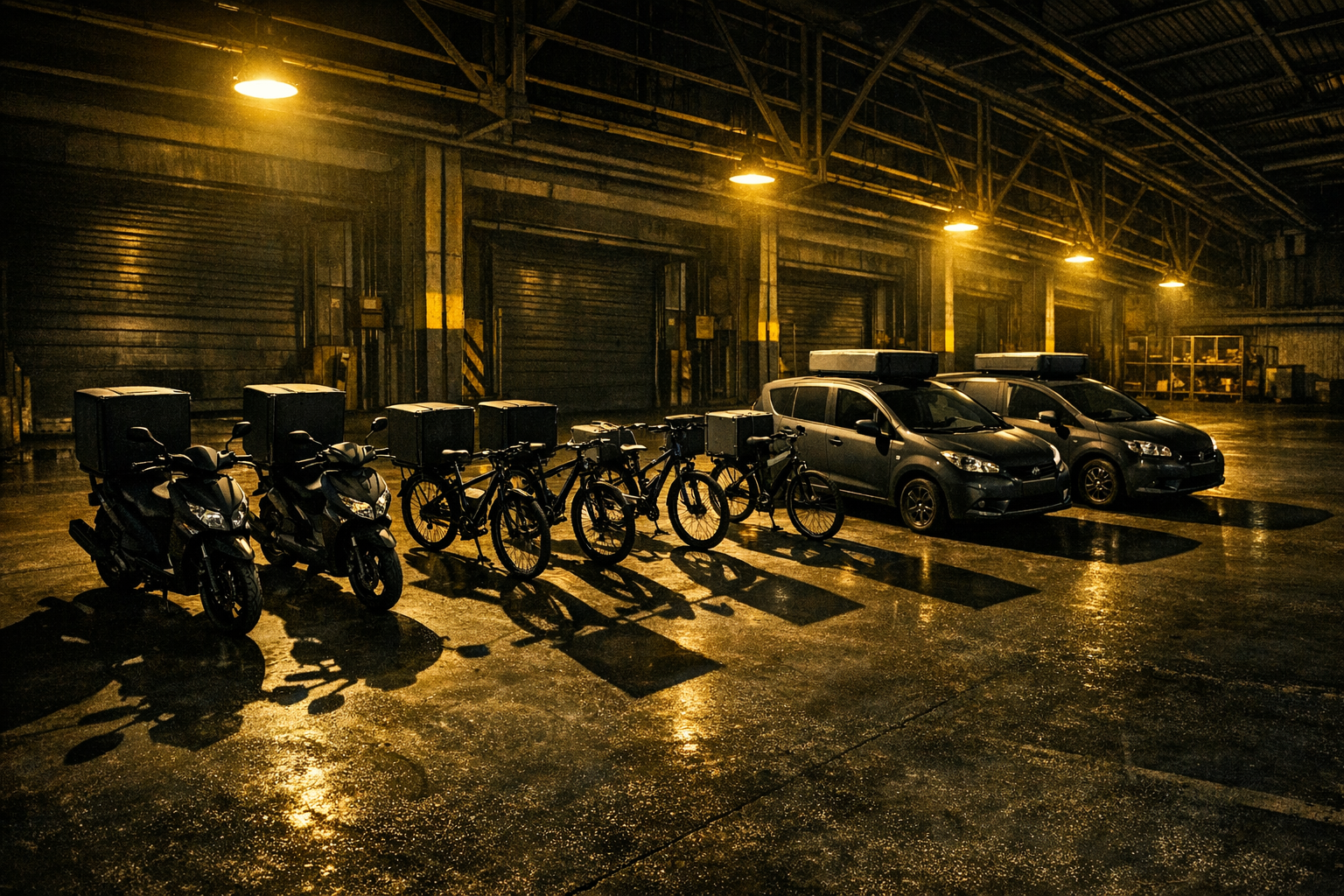
Pizza delivery vehicle fleet in industrial depot β€” motorcycles, bicycles and cars

Fleet Selection Principle

Operators in high-density urban cores (population density above 10,000 per sq. mile) typically favor two-wheel transport for its parking flexibility and lane-splitting efficiency. Suburban operators (below 3,000 per sq. mile) default to car-based fleets for cargo capacity and weather protection.
Delivery Vehicle Categories

Each vehicle type fills a specific niche in the pizza delivery transport ecosystem, defined by its operational environment and cargo characteristics.

Urban Core

Bicycles & E-Bikes

In the densest urban markets β€” downtown cores of cities like New York, Chicago, San Francisco, and Boston β€” pedal-powered and electric-assist bicycles represent the most efficient pizza delivery vehicle available. Their primary advantage is not speed but navigational flexibility: they can use bike lanes, cut through traffic gridlock, and park at building entrances without circling blocks for a spot.

Standard cargo delivery bicycles are fitted with front or rear rack systems that accommodate standard insulated pizza bags. Electric-assist models extend the viable delivery radius from approximately 1.5 miles to 3–4 miles while maintaining the urban mobility advantages of the bicycle platform. Battery range on most commercial e-bike delivery units spans 40–70 miles per charge, sufficient for a full shift in most markets.

  • Effective delivery radius: 0.5–4 miles depending on assist level
  • Average urban speed: 10–16 mph including stops
  • Cargo capacity: 1–3 standard pizza boxes (rear rack bag)
  • Parking: Door-to-door, zero search time in most cases
  • Weather limitation: Significant in rain, ice, or extreme cold
Delivery bicycles with insulated cargo bags in depot
Urban & Suburban

Motorcycles & Mopeds

Gas-powered motorcycles and 50cc–150cc mopeds occupy the middle tier of pizza delivery transport β€” faster than bicycles, more maneuverable than cars, and capable of operating in a wider range of weather conditions. In moderately dense markets such as mid-sized U.S. cities (population 200,000–1,000,000), motorcycle-class vehicles often dominate fleet composition.

The standard pizza motorcycle configuration involves a topcase or tail-mounted insulated box β€” a hard-shell carrier with internal thermal lining that holds two to four standard 12"–16" pizza boxes horizontally. These boxes are engineered to maintain a level platform regardless of vehicle pitch or lean, preventing topping displacement during cornering. Mounting systems use quick-release brackets for rapid loading at the pickup point.

  • Effective delivery radius: 2–8 miles typical range
  • Average speed: 25–40 mph across mixed urban roads
  • Cargo capacity: 2–4 boxes in standard tail-mount carrier
  • Parking: High flexibility; minimal lot space required
  • Licensing: Requires motorcycle license in most U.S. states
Delivery motorcycles with thermal cargo carriers
Suburban & Rural

Passenger Cars & SUVs

In suburban and exurban U.S. markets β€” which represent the majority of delivery zones by geographic area β€” passenger cars are the dominant pizza delivery vehicle. The car platform offers critical advantages for these environments: high cargo capacity (multiple stacked orders, large-format boxes), full weather protection, greater driver comfort on longer routes, and the ability to handle non-standard orders that exceed bicycle or motorcycle capacity limits.

Delivery car configurations typically involve flat insulated bags placed on a level rear seat or trunk surface. Some operations use purpose-built vehicle insert systems β€” rigid flat platforms with non-slip surfaces that fit into car trunks β€” to create a stable, level transport environment for stacked boxes. These inserts prevent the boxes from sliding or tilting during acceleration, braking, and turning.

  • Effective delivery radius: 3–12 miles typical suburban range
  • Average speed: 30–55 mph on suburban arterials
  • Cargo capacity: 4–12 boxes depending on configuration
  • Multi-stop capable: Yes β€” 2–4 stops per run common
  • Weather resilience: Full β€” all U.S. climate conditions
Delivery cars with roof-mounted insulated boxes in parking area

Vehicle Method Comparison

Key operational attributes across the primary pizza delivery transport categories used in U.S. markets.

Vehicle Type Typical Radius Max Capacity Weather Tolerance Best Market Type Parking Ease
Pedal Bicycle 0.5–2 mi 2–3 boxes Low Dense urban core ⭐⭐⭐⭐⭐
E-Bike / E-Scooter 1–4 mi 2–4 boxes Low–Medium Urban / inner suburban ⭐⭐⭐⭐⭐
Moped (50–150cc) 2–6 mi 3–4 boxes Medium Urban / mixed suburban ⭐⭐⭐⭐
Motorcycle 2–8 mi 4–6 boxes Medium–High Suburban arterial zones ⭐⭐⭐⭐
Compact Car 3–10 mi 6–10 boxes High Suburban / exurban ⭐⭐⭐
SUV / Van 4–15 mi 10–20+ boxes Very High Rural / batch delivery ⭐⭐

Delivery Route Strategies

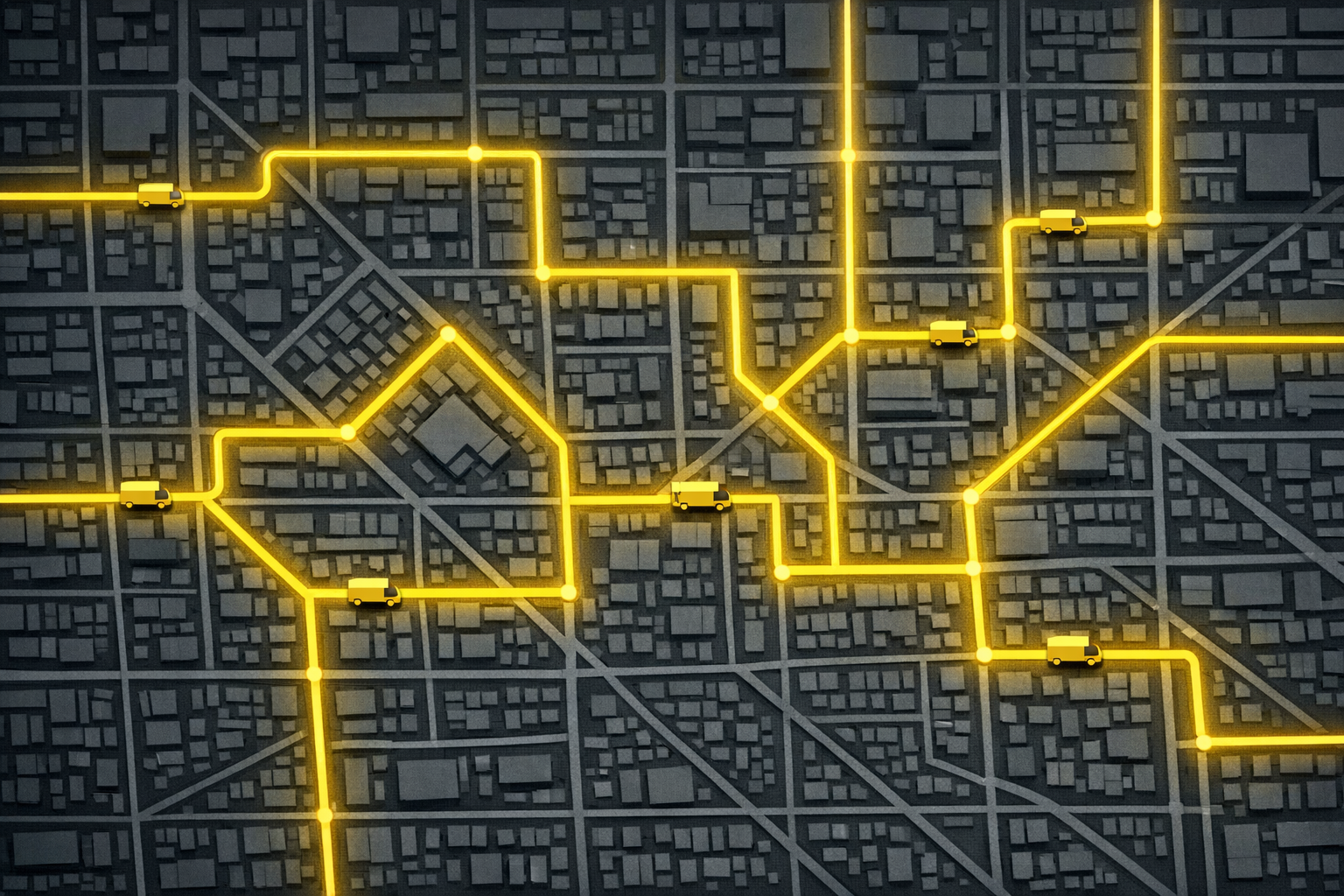
Urban delivery route map with optimized yellow route lines

How Delivery Routes Are Planned

Pizza delivery routes are not simply the fastest path between two points. They are dynamically calculated trade-offs between speed, road type compatibility (based on vehicle class), traffic density, estimated preparation time at origin, and β€” in multi-stop scenarios β€” the sequencing of delivery addresses to minimize total elapsed time across all stops.

Route planning systems for pizza delivery use graph-based algorithms β€” most commonly variants of Dijkstra's algorithm or A* search β€” applied to real-time weighted road network graphs. Edge weights in these graphs represent not just distance but current travel time, updated using live traffic feeds. The result is a route that reflects actual conditions at the moment of dispatch rather than static road distance.

  • Single-stop routes: Straightforward fastest-path calculation from origin to single address
  • Multi-stop routes: Traveling salesman optimization across 2–4 stops per driver run
  • Dynamic rerouting: Real-time recalculation triggered by traffic incidents or driver deviation
  • Zone-aware routing: Routes kept within the driver's assigned delivery zone when possible
πŸ•

Time-Window Constraints

Every pizza delivery operates within a hard time window β€” the maximum elapsed time from oven exit to customer handoff. Route planning systems are not simply optimizing for speed in the abstract; they are ensuring that the food remains within the safe temperature range (above 140Β°F) for the entire transit duration. Route length is therefore bounded by thermal physics as well as customer expectation.

πŸ”€

Multi-Stop Sequencing

When a driver carries two or more orders simultaneously, the delivery sequence must be optimized to minimize total travel time while accounting for per-order time windows. Systems typically use nearest-neighbor heuristics or small-instance exact solvers to determine stop order. The first delivery is almost always the address closest to the origin to minimize degradation of the first order's temperature.

🌧️

Weather & Condition Adjustments

Adverse weather conditions require route planning adjustments beyond simply adding buffer time. Rain and snow reduce bicycle and motorcycle viability, triggering automatic vehicle class reassignment in fleet management systems. Route weights are also adjusted upward for known flood-prone roads, steep grades that become dangerous in ice, and highway segments where wind creates hazards for two-wheel vehicles.

Next: Heat Retention Technology

Transport gets the pizza to the door β€” but thermal management keeps it hot. Explore the insulation materials, packaging engineering, and temperature standards that preserve pizza quality during transit.

Explore Heat Retention β†’