Thermal Engineering

Pizza Delivery Heat Retention

A deep-dive into the insulation materials, thermal packaging architecture, and temperature management standards that keep pizza at safe serving temperatures from oven exit to doorstep delivery.

ℹ️ This page covers the science and engineering of thermal management in pizza delivery. Pizza Logistics Hub provides this information for educational purposes only and is not affiliated with any food service or delivery operation.

Why Heat Retention Matters

When a pizza exits a commercial oven, it typically measures between 155°F and 185°F at the surface — well within safe food service temperature standards. The challenge of delivery logistics is maintaining that temperature above 140°F (the FDA-recognized minimum hot holding temperature for cooked food safety) throughout the entire transit window, which can span 15–45 minutes depending on route length and market density.

Heat loss in transit occurs through three physical mechanisms: conduction (heat transfer through direct contact with cooler surfaces), convection (heat loss via air movement around the food), and radiation (infrared heat emission from the food surface into the surrounding environment). Effective thermal packaging systems address all three mechanisms simultaneously.

The engineering of pizza delivery packaging is therefore not a cosmetic concern — it is a food safety and quality imperative governed by physics and regulated by public health standards.
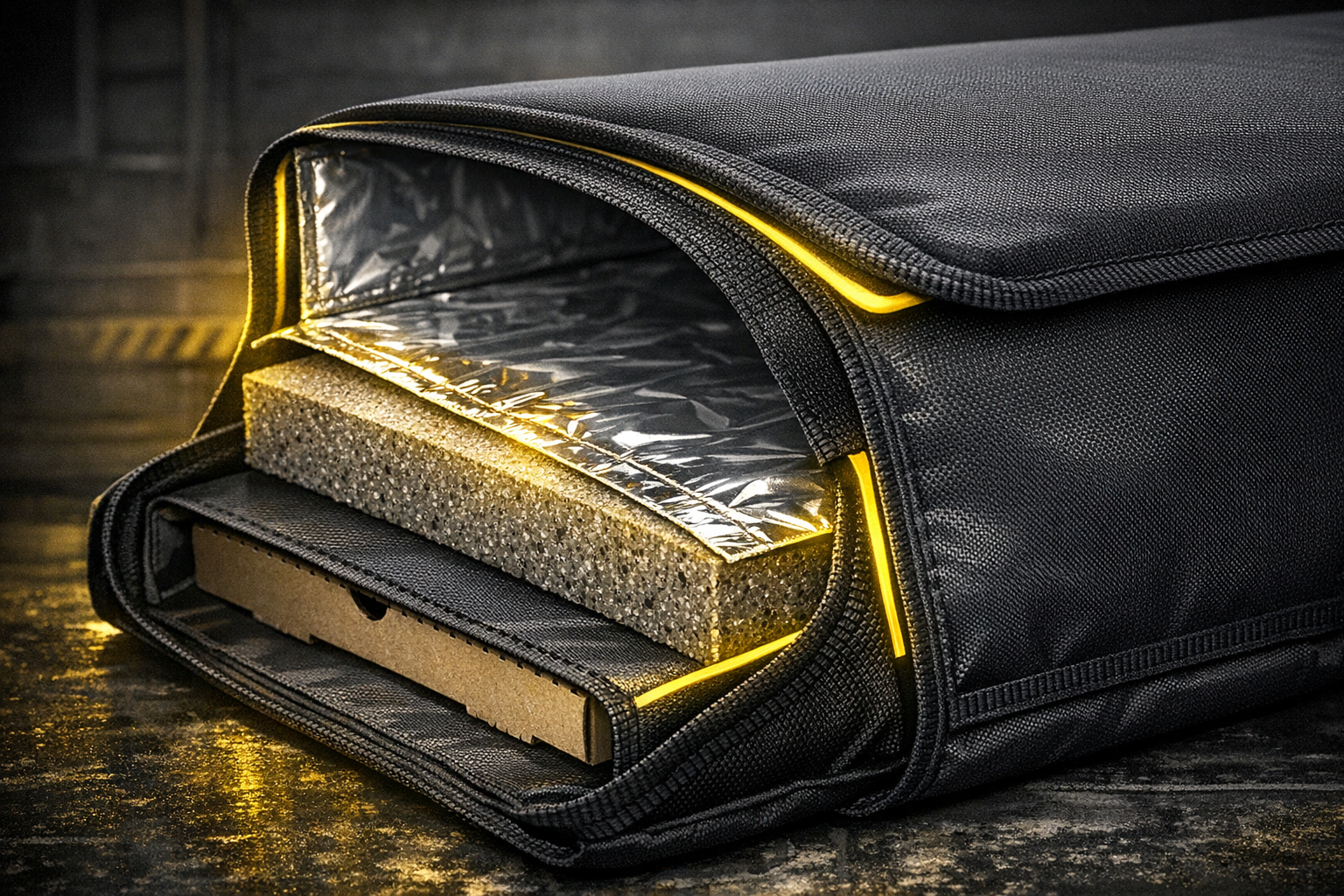
Cross-section of insulated pizza delivery bag showing thermal layers

The 140°F Standard

The U.S. Food and Drug Administration's Food Code establishes 140°F (60°C) as the minimum safe holding temperature for hot cooked food. Any pizza delivery system must be engineered to maintain temperatures above this threshold from oven exit to customer receipt — a non-negotiable food safety boundary.
Heat Loss Over Time

Understanding how quickly pizza loses heat in different packaging configurations is fundamental to delivery system design.

160°F Avg. Oven Exit Temp Pizza surface temperature at packaging point
~3°F Per Minute Heat Loss Uninsulated cardboard box, ambient 68°F
<1°F Per Minute Heat Loss Quality insulated delivery bag system
Packaging Type At 0 min (Exit) At 10 min At 20 min At 30 min FDA Safe? (≥140°F)
No packaging (bare) 160°F 130°F 108°F 92°F ✗ Fails at ~7 min
Standard cardboard box only 160°F 142°F 128°F 116°F ✗ Fails at ~12 min
Box + basic insulated bag 160°F 153°F 146°F 139°F ⚠ Marginal at 30 min
Box + premium insulated bag 160°F 156°F 152°F 147°F ✓ Safe to 35+ min
Box + heated delivery bag 160°F 158°F 156°F 154°F ✓ Safe to 45+ min

* Approximate values based on standard thermal physics modeling at 68°F ambient temperature. Actual performance varies with environmental conditions, box size, and specific material specifications.

Insulation Layer Architecture

Modern pizza delivery bags are engineered with multiple material layers, each targeting a specific heat transfer mechanism.

🔆

Reflective Mylar Lining

The innermost layer of virtually all commercial pizza delivery bags is a metallized polyester (Mylar) film that reflects infrared radiation back toward the food. This directly counters radiative heat loss — the dominant mechanism at the high temperature differential present immediately after oven exit. Mylar's emissivity coefficient (typically 0.03–0.05) is dramatically lower than uncoated surfaces, reflecting up to 97% of radiant heat.

🧱

Closed-Cell Foam Core

Sandwiched between the reflective inner liner and the outer shell is a closed-cell polyethylene or EVA foam layer, typically 10–20mm thick. Closed-cell foam's low thermal conductivity (k-value approximately 0.035–0.045 W/m·K) severely limits conductive heat transfer through the bag wall. The sealed cell structure also prevents moisture absorption, which would degrade insulating performance over repeated use cycles.

🧵

Outer Nylon Shell

The outer shell of a delivery bag serves dual purposes: structural integrity and secondary insulation. Heavy-duty 600D–1200D Oxford nylon provides abrasion resistance for the repeated loading, transit, and handling cycles a delivery bag experiences. Some premium bags incorporate an additional fleece or fiberfill layer between the foam core and outer shell for enhanced convective resistance, particularly effective in cold ambient conditions.

🔒

Sealed Closure Systems

Even the highest-performance insulating materials are defeated by a poorly designed closure system. The most thermally effective pizza delivery bags use full-perimeter zipper closures with insulated flaps that eliminate cold-air infiltration at the opening edge. Hook-and-loop (Velcro) closures are common in lower-tier bags but allow measurable convective air exchange. Zipper-sealed bags can maintain a near-static internal air volume, dramatically reducing convective losses.

Active Heating Elements

Advanced delivery bag systems incorporate resistive heating elements — thin-film carbon fiber or nichrome wire circuits embedded within the bag wall — connected to vehicle power outlets (12V DC) during transit. These systems can maintain internal temperatures within a set range (typically 150–165°F) regardless of ambient conditions or transit duration, effectively eliminating heat retention as a delivery time constraint. Penetration of active-heat bags in U.S. fleets has increased significantly post-2018.

📐

Form-Fitting Geometry

Bag geometry is an underappreciated thermal management factor. A delivery bag that precisely fits the pizza box dimensions minimizes the volume of air trapped between box and bag wall. Excess air volume increases convective circulation within the bag, accelerating heat loss. Well-engineered bags are sized to accommodate standard box dimensions (10", 12", 14", 16" round or square) with minimal excess clearance — a design constraint that also prevents box shifting during transit.

Pizza Box Engineering

The Corrugated Box as a Thermal Device

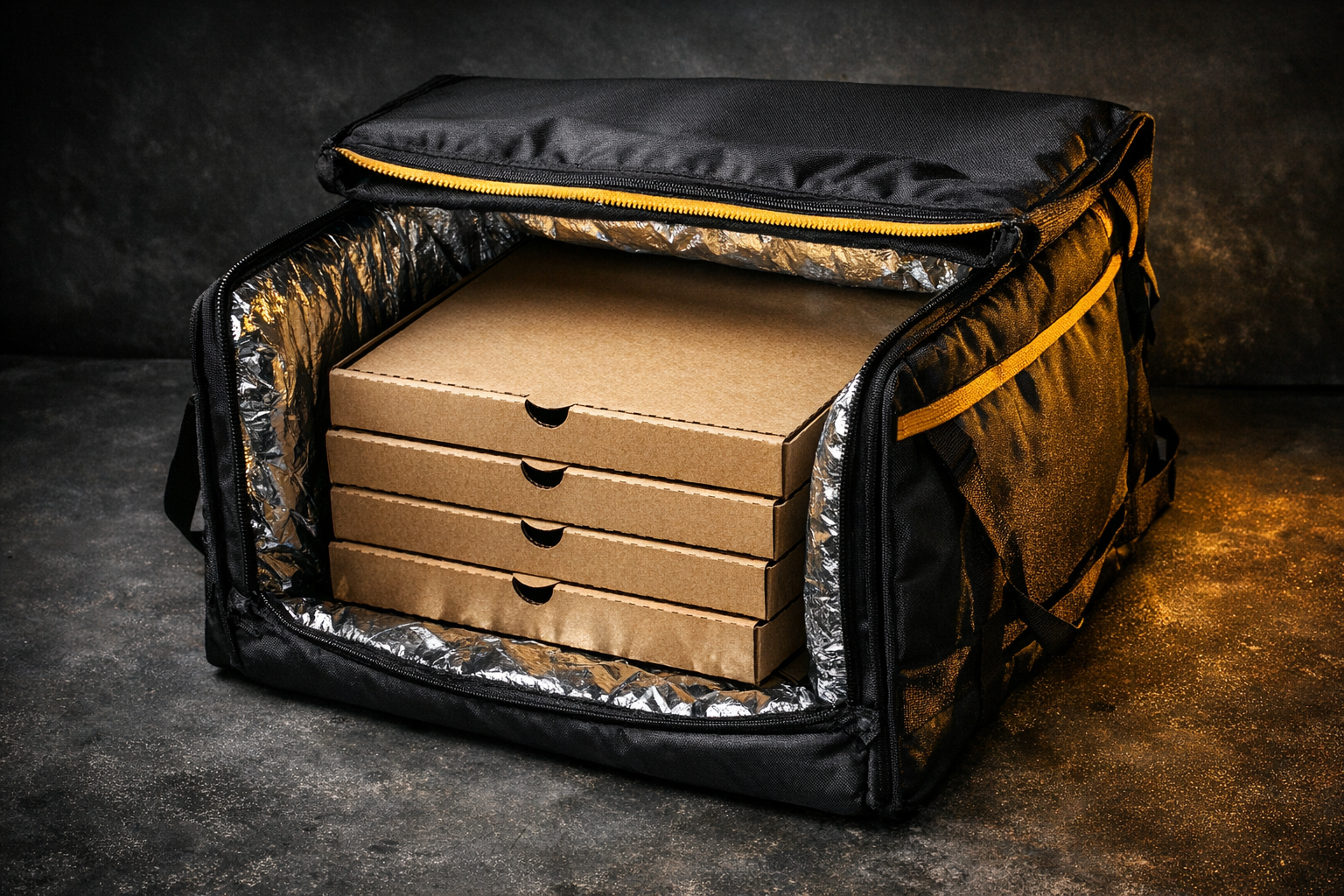
The standard pizza delivery box is a single-use corrugated cardboard container — but its design is more thermally sophisticated than it appears. The corrugated structure (a fluted medium sandwiched between two flat linerboards) creates an array of small, trapped air cells within the wall material. Trapped air is one of the most effective insulating media available, and the corrugated architecture exploits this at low cost and weight.

The thermal conductivity of corrugated cardboard is approximately 0.06 W/m·K — significantly lower than solid materials — meaning a standard 4mm-thick pizza box wall provides meaningful resistance to conductive heat transfer. While this is insufficient on its own for delivery timelines, it acts as an effective secondary insulating layer within a delivery bag system.

  • Corrugated wall: ~4–6mm thickness, trapped air cells throughout
  • Ventilation holes: Present in some designs to manage steam, absent in delivery-optimized boxes
  • Double-wall variants: Available for extended transit windows (>30 minutes)
  • Moisture resistance: Wax-coated or PE-laminated variants prevent sogginess from steam condensation
Stacked pizza boxes inside insulated delivery bag

Steam Management & Crust Integrity

A critical but often overlooked aspect of pizza packaging engineering is steam management. As pizza cools, steam released from the toppings and crust condenses on cooler surfaces — including the underside of the box lid and the crust itself. Excess condensate absorption by the crust produces sogginess, degrading texture quality independent of temperature.

Delivery-optimized pizza boxes address this through several strategies. Elevated base inserts — cardboard or molded pulp platforms that raise the pizza above the box floor — allow steam to dissipate downward rather than pooling under the crust. Some box designs incorporate micro-perforated lids that allow controlled steam escape without creating significant convective heat loss. The balance between steam venting and heat retention is a central design trade-off in pizza box engineering.

  • Elevated base inserts lift pizza 3–8mm above box floor
  • Micro-perforated lids: controlled steam release without major heat loss
  • Corrugated lid fluting: channels steam laterally toward vents
  • Moisture-barrier coatings: prevent crust contact with condensate
Insulated pizza delivery bag with thermal lining detail

Temperature Standards & Compliance

FDA Food Code Requirements

The U.S. Food and Drug Administration's Model Food Code (adopted in full or in part by most states) requires that hot potentially hazardous food be maintained at or above 140°F (60°C) during holding and transport. For pizza delivery, this creates a hard engineering constraint: the entire packaging system must be capable of maintaining this minimum temperature for the maximum expected transit window in the operator's market.

USDA & State Health Department Oversight

While the FDA sets the baseline temperature standard, enforcement of food transport temperature requirements falls primarily to state and local health departments. Inspection protocols vary significantly by jurisdiction, but most require delivery operators to demonstrate — through equipment certification or temperature logging — that their packaging systems are capable of maintaining compliant temperatures throughout the delivery window.

NSF International Certification

NSF International (formerly the National Sanitation Foundation) provides third-party testing and certification for food equipment including delivery bags. NSF certification validates that a delivery bag's materials are non-toxic, cleanable, and structurally capable of maintaining the manufacturer's claimed thermal performance specifications. NSF-certified bags are the accepted standard for compliance in most U.S. jurisdictions with active inspection programs.

ISTA Packaging Testing Protocols

The International Safe Transit Association (ISTA) has developed testing protocols applicable to food transport packaging, including thermal performance evaluation under simulated transit conditions. ISTA testing subjects packaging to combined thermal, vibration, and humidity environments that replicate real delivery conditions, providing more predictive performance data than laboratory-only thermal testing.

Have More Questions?

Visit the FAQ section for concise answers to the most common questions about pizza delivery systems, transport, and what this website covers.

Go to FAQ →